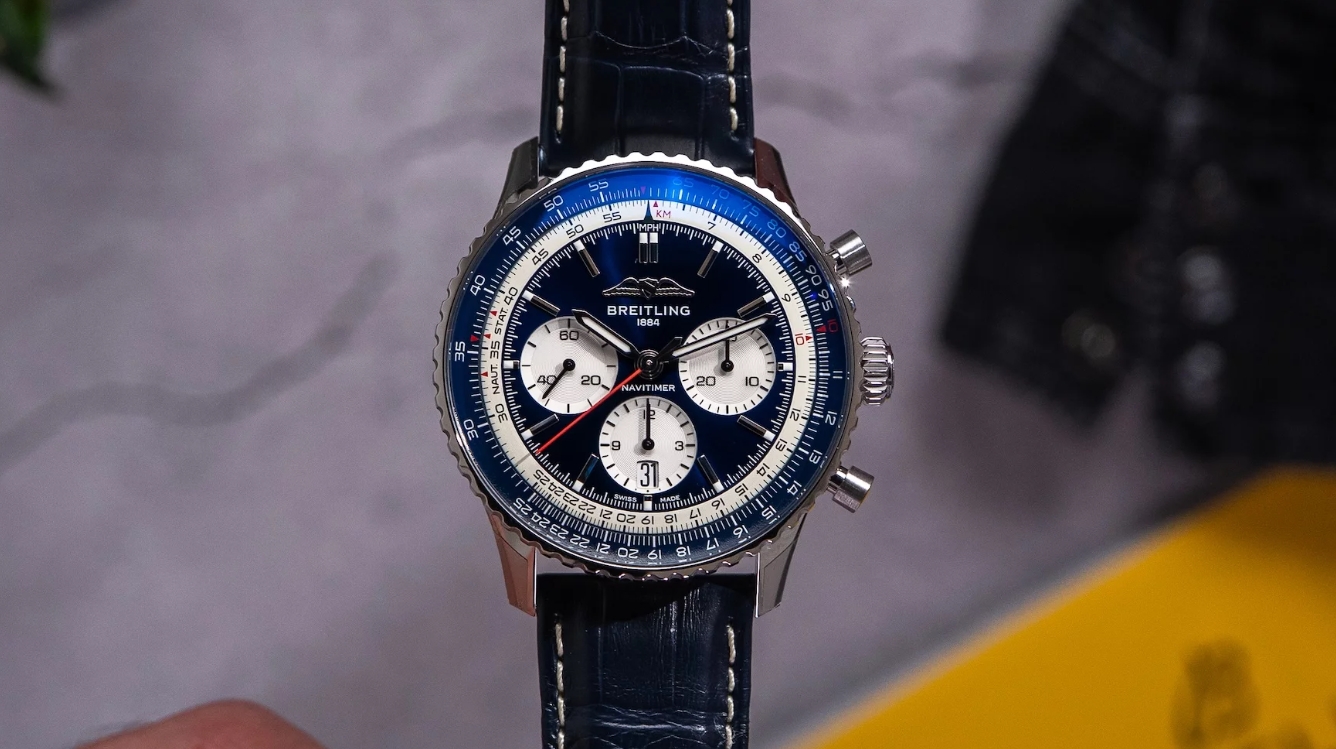
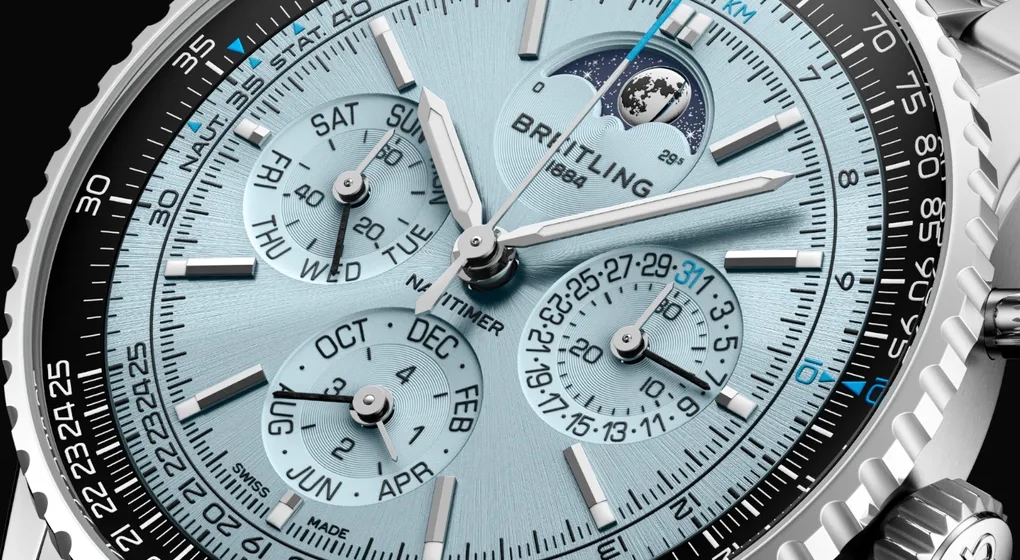
The Navitimer Cosmonaute makes more sense once it is viewed as a watch designed around an unusual environment rather than as a normal chronograph with a different dial. In orbit, repeated sunrises and sunsets remove the everyday visual cues that help distinguish morning from evening. A 24-hour display therefore becomes practical rather than decorative.
Breitling marked the Cosmonaute’s 60th anniversary in 2022 at a space-themed event co-hosted with former NASA astronaut Scott Kelly. The historical reference remains Scott Carpenter, who wore a Cosmonaute during the Aurora 7 mission in 1962. That connection is why the model belongs naturally within the Navitimer family but still feels unlike a standard Navitimer.

The first thing to understand is the dial. A conventional watch completes two twelve-hour rotations per day; the Cosmonaute’s hour hand works around a full 24-hour scale. That changes the position and density of the numerals, while the slide-rule bezel and chronograph registers add another layer of information. On a Cosmonaute replica interpretation, those relationships are more important than any generic claim of being “1:1”.
Where comparisons should focus
Look closely at 24-hour numeral spacing, sub-dial placement, slide-rule printing and the length of the hands. Small errors can make the entire dial feel wrong because the genuine watch is already visually complex. Case thickness and bezel proportions also matter, but the dial remains the defining feature.

The Cosmonaute also has historical significance beyond its unusual dial. Scott Carpenter’s 1962 mission made the concept part of space-watch history, while the 2022 anniversary brought renewed attention to the model. That context is more useful than presenting the watch as merely another limited or collectible Navitimer.
At Nurluk, we separate genuine Breitling specifications from replica specifications. A replica may imitate the 24-hour appearance without using the same movement architecture, water resistance or materials. That distinction is particularly important with the Cosmonaute, where the functional concept is part of the watch’s history rather than simply a styling cue.